
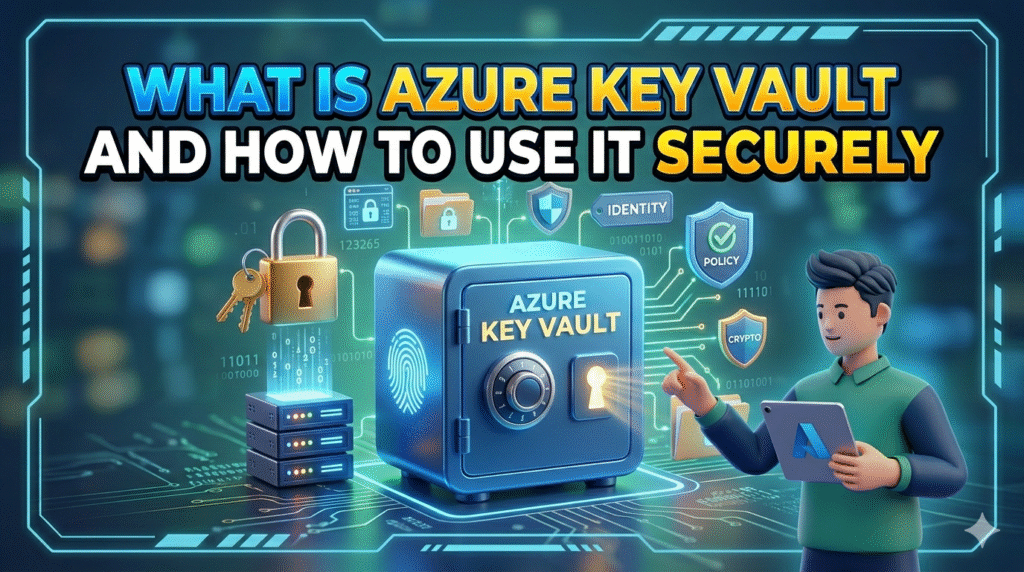
When building cloud applications, one of the biggest challenges is securely managing secrets like API keys, connection strings, and certificates. Hardcoding these values in your code is risky and can lead to serious security breaches.
This is where Azure Key Vault comes in.
☁️ What is Azure Key Vault?
Azure Key Vault is a cloud service that helps you securely store and manage sensitive information such as:
- 🔑 Secrets (API keys, passwords, connection strings)
- 📜 Certificates (SSL/TLS)
- 🔐 Cryptographic keys (for encryption/decryption)
It acts like a secure vault where only authorized users and applications can access sensitive data.
🚀 Why Use Azure Key Vault?
✅ Centralized Secret Management
Store all secrets in one secure place instead of spreading them across code or configs.
🔐 Enhanced Security
- Secrets are encrypted at rest
- Access is controlled via identity-based authentication
🔄 Automatic Key Rotation
Helps reduce risk by rotating secrets periodically.
📊 Monitoring & Logging
Track who accessed what and when.
🧩 How Azure Key Vault Works
- You create a Key Vault instance
- Store secrets/keys/certificates inside it
- Configure access policies or RBAC
- Applications securely retrieve secrets at runtime
🔑 How to Use Azure Key Vault (Basic Flow)
Step 1: Create a Key Vault
Using Azure Portal or CLI:
az keyvault create --name MyKeyVault --resource-group MyRG
Step 2: Add a Secret
az keyvault secret set --vault-name MyKeyVault --name "DbPassword" --value "MyStrongPassword"
Step 3: Access the Secret in Code (.NET)
var client = new SecretClient(
    new Uri("https://mykeyvault.vault.azure.net/"),
    new DefaultAzureCredential());

KeyVaultSecret secret = await client.GetSecretAsync("DbPassword");
Console.WriteLine(secret.Value);
🔐 How to Authenticate to Azure Key Vault (Most Important)
Secure access to Key Vault is powered by Microsoft Entra ID.
Let’s explore the main authentication methods 👇
🥇 1. Managed Identity (Best Practice)
Managed Identity is the most secure and recommended approach.
💡 How it works:
- Enable Managed Identity on your Azure resource
- Grant it access to Key Vault
- Use
DefaultAzureCredentialin code
🔐 Benefits:
- No secrets stored in code
- Automatic token management
- Seamless integration with Azure services
👉 Example:
var credential = new DefaultAzureCredential();
🧑💻 2. Service Principal (Client ID + Secret)
Used when apps run outside Azure (e.g., local machine, CI/CD pipelines)
💡 How it works:
- Register an app in Entra ID
- Use Client ID + Client Secret
⚠️ Drawback:
- You must securely store the secret (prefer Key Vault itself!)
💻 3. Azure CLI Authentication
Useful during development.
az login
Your application can then use your logged-in identity.
🔑 4. Certificate-Based Authentication
Instead of client secrets, use certificates for higher security.
🛡️ Securing Access to Key Vault
🔹 Use Role-Based Access Control (RBAC)
Assign roles like:
- Key Vault Secrets User
- Key Vault Reader
🔹 Enable Firewall & Network Restrictions
- Allow only trusted IPs or VNets
🔹 Use Private Endpoints
Ensure traffic stays within Azure network
🔹 Enable Logging & Monitoring
Track access via Azure Monitor
⚖️ Managed Identity vs Service Principal
| Feature | Managed Identity | Service Principal |
|---|---|---|
| Credential Management | ❌ Not required | ✅ Required |
| Security | ⭐⭐⭐⭐⭐ | ⭐⭐⭐ |
| Best For | Azure-hosted apps | External apps |
🧠 Best Practices
- ✅ Always prefer Managed Identity
- 🔐 Never store secrets in code or config files
- 🔄 Rotate secrets regularly
- 📊 Monitor access logs
- 🔑 Use least-privilege access
🚀 Conclusion
Azure Key Vault is an essential service for building secure, production-ready Azure applications.
By combining it with Managed Identity and Microsoft Entra ID, you can:
✔ Eliminate credential leaks
✔ Strengthen security
✔ Simplify secret management
If you’re working with Azure (especially .NET or Python apps), integrating Key Vault should be a top priority in your architecture.
Happy coding and stay secure! 🔐🚀